
Bathroom Drywall Repair in Grimsby: Rebuilding After a Leak
Updated October 18, 2026
Once the source has been addressed, rebuilding still needs a clear plan. Define the repair boundary, retained finishes and acceptance stages before closing the wall.
- Trusted since 2005
- Fully insured
- Dust-controlled sanding
- Paint-ready finishing
- 3-year workmanship warranty
Quick Answer
Drywall reinstatement comes after the leak source and any required drying or remediation have been addressed. Confirm who establishes readiness, document the affected assembly, and quote replacement, joint finishing, primer and paint separately from investigation. The visible stain alone does not define how much work is needed.
Bathroom drywall repair in Grimsby after a leak should begin with a clear handoff from the people who investigated and addressed the source. Before closing a wall or ceiling, establish what work has been completed, what remains uncertain and who confirms readiness for reinstatement. A dry-looking stain is not enough information to specify the entire repair, and a freshly painted surface cannot resolve an ongoing leak.
EPF's drywall repair service can address the rebuilding and finishing scope once the relevant conditions have been resolved. This guide covers that reinstatement stage. It explains repair boundaries, material matching, trade coordination, quote comparison and the final walkthrough. It is not an emergency-response or mould-remediation procedure, and it does not replace assessment by the appropriate professionals.
Separate source repair, remediation and reinstatement
| Stage | Question to settle | Useful record |
|---|---|---|
| Source investigation | What caused the water and who addressed it? | Trade report, work description or relevant correspondence |
| Readiness for enclosure | Is drying or remediation complete as required? | Confirmation from the responsible professional |
| Repair scope | What assembly and surfaces will be restored? | Photos, marked boundaries and material notes |
| Finishing | Where do primer and paint stop? | Written finish specification and repaint limits |
| Handover | What was completed and what remains separate? | Walkthrough notes and product information |
These stages may involve different businesses. Do not assume that a contractor hired to replace board has also accepted responsibility for diagnosing the leak or assessing hidden contamination. Ask each party to state its role. A short written handoff can prevent a finished repair from becoming the place where an earlier unresolved question finally comes to light.
Keep the discussion factual. Record what happened, when it was noticed and what work you know has been completed. Avoid turning an initial guess into a confirmed cause when passing information between trades. If the source remains uncertain, say so. That honesty helps the responsible professional decide what must happen before the wall is ready to be closed.
Document the room before finishes hide the evidence
Take wide photographs from the doorway and closer views of the affected area where it is safe to do so. Include nearby fixtures, wall corners, trim and the ceiling. The wide view gives the repair context; close-ups show the visible condition. Do not remove material or enter an unsafe area just to improve the photograph. The assessment determines what can be accessed safely.
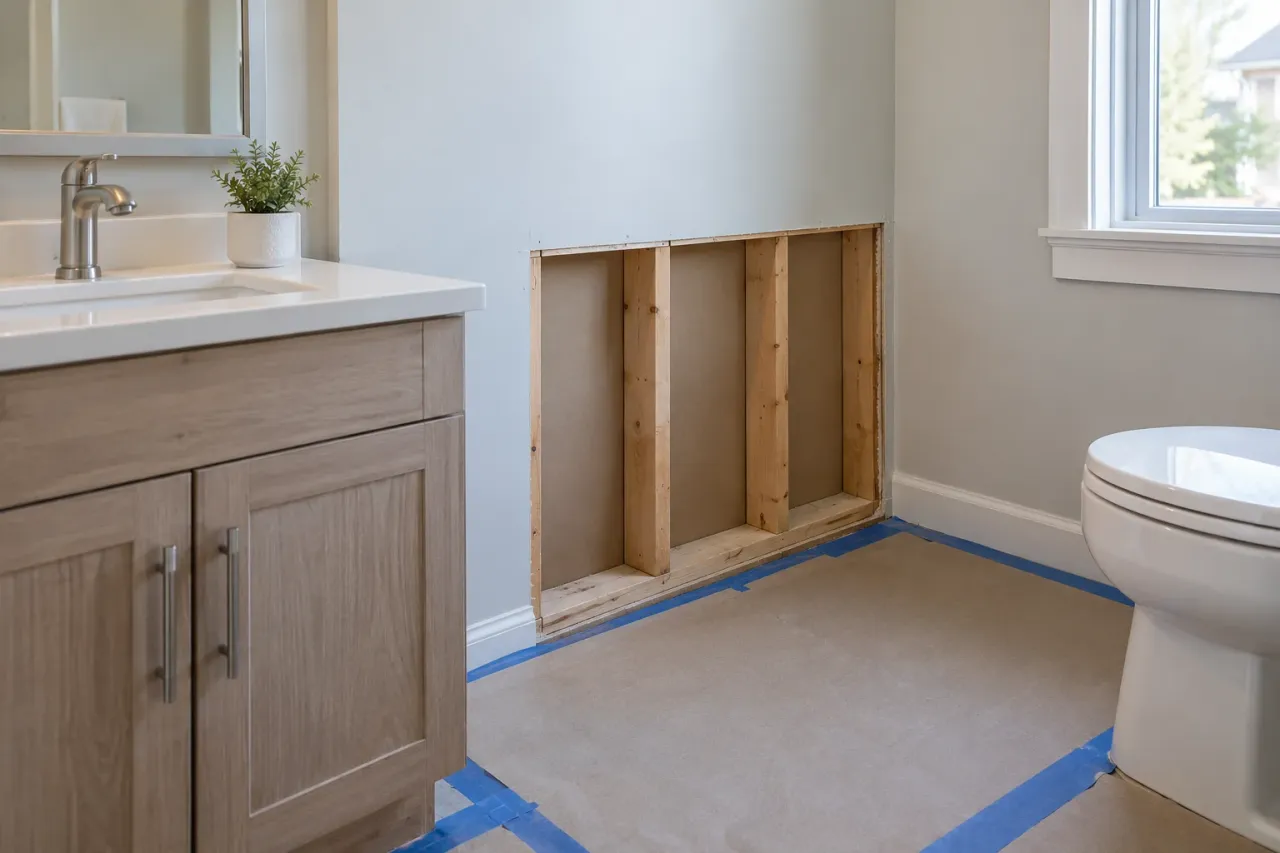
If a wall has already been opened by the relevant professional, retain useful photographs of the assembly and work completed. Ask for the information needed to rebuild it correctly. Material layers, existing thickness and support details may not be obvious once the opening is covered. A project record reduces reliance on memory and helps the quotation describe reinstatement more precisely.
For an insurance-related project, coordinate documentation and approvals with the insurer or restoration contact as applicable. Coverage and authorization are specific to the situation; a drywall estimate should not promise what an insurer will pay. Keep the physical repair scope clear even when another party is involved in approving or funding the work.
Decide who confirms the area is ready for rebuilding
Readiness belongs to the actual condition and the professionals responsible for resolving it. Ask what confirmation is required before new board is installed and who will provide it. This is especially important when several trades have visited at different times. The last person to leave the room is not automatically the person qualified to approve enclosure.
Health Canada's moisture and mould guidance emphasizes correcting moisture sources and obtaining appropriate assessment for hidden or extensive problems. Keep those tasks separate from cosmetic finishing. Do not cover suspected affected material simply because it falls behind a vanity or will be hidden by new tile.
If the condition changes before boarding, revisit the handoff. A new stain, unexplained dampness or another concern is relevant information rather than an inconvenience to conceal to keep the schedule. The repair date should follow the necessary confirmation. That may be less convenient than a fixed calendar promise, but it protects the value of the finishing work that comes afterward.
Set the replacement boundary from sound material and support
The outline of a stain is not necessarily the appropriate cut line. The contractor needs to assess the surrounding material, the support available for a connection and the finishing space around the new section. A small visible mark can require a wider repair, while a broad discolouration does not alone establish that every sheet must be replaced. The boundary should be explained after assessment.
Corners, fixtures and tile edges affect that boundary. A narrow strip left between a new patch and an existing corner may be awkward to support and finish. Removing more material can sometimes create a clearer repair, but it can also disturb a retained finish unnecessarily. Ask the contractor to explain the practical trade-off rather than treating either minimal cutting or full replacement as a universal rule.
A useful estimate identifies the visible scope and the assumptions about what remains behind it. If opening or preparation reveals additional problems, the contractor should show the condition and propose a revised boundary. Agree how extra work is priced before it proceeds. That keeps the repair accountable while allowing for facts that could not be established from the original photographs.
Match the assembly before matching the paint
New drywall must connect appropriately to the retained wall or ceiling. Board thickness and the existing layers affect the plane of the surface. A replacement that sits proud or recessed can create unnecessary finishing work and a visible transition. Ask how the contractor will identify and match the relevant assembly rather than choosing a sheet only because it is available.
Some walls or ceilings have performance requirements that must be preserved. If the existing assembly is uncertain, the responsible qualified professional should establish the requirements before it is changed. The repair scope should follow that information. A decorative finish cannot compensate for missing or unsuitable components behind the face, and the homeowner should not have to guess at an assembly from its appearance.
If broader replacement is necessary, drywall installation in Grimsby may be part of the scope alongside local repairs. Clarify the connection between these tasks so the quotation does not leave an unfinished boundary. The goal is a coherent restored surface with the necessary support and preparation, not several separately priced pieces that nobody agrees to blend.
Coordinate the bathroom fixtures and wet-area system
A leak repair can coincide with plumbing or fixture changes, but those changes need their own confirmed scope. Identify which items are being retained, disconnected, replaced or relocated and who is responsible. Drywall should not be closed around an unfinished task. The relevant trades should confirm their work and any required checks before the finisher treats the area as ready.
Where the repair affects a shower or tub assembly, involve its responsible installer before reinstatement. A patch that looks acceptable on a painted wall may not be an appropriate repair to the selected waterproofing system. The installer needs to establish the compatible backing, boundary and method. Our bathroom materials guide explains the difference between choosing board and specifying a complete assembly.
Retained tile can make the boundary particularly important. Ask whether it can stay, what would be disturbed and how the finished transition will be handled. Do not assume a bead of sealant makes every altered joint acceptable. The written scope should identify the trade making that decision and the information needed before drywall work begins around it.
Protect retained finishes while rebuilding the damaged area
The bathroom may contain perfectly serviceable fixtures and finishes beside the damaged wall. List what must be protected and what access the crew needs. A vanity close to the opening can limit tool movement and finishing space. Decide whether it stays in place or whether the appropriate trade will remove it before the drywall contractor prices the work.
Consider the route to the room as well. New sheets, removed material and equipment may pass through a hallway or stairs with finished surfaces. Confirm protection, handling and cleanup expectations before starting. For a Grimsby managed property, check the actual building arrangements; for a house, describe the practical access. Neither the city nor the room size determines those conditions on its own.
Keep the storage area clear and suitable for the materials. The household should know which room or route is temporarily part of the work zone. Remove small belongings before protection is installed and agree when they can return. Repeatedly uncovering fixtures or moving equipment to use the room can disrupt the sequence and create confusion about whether the space has been released.
Blend the replacement into the retained surface
Once suitable backing is in place, the finishing work should create an even transition. Joints and edges need appropriate treatment before sanding and inspection. The repair may extend beyond the replacement board to feather it into the surrounding plane. A narrow finish around a large patch can leave a visible outline even when the new board itself is properly supported.
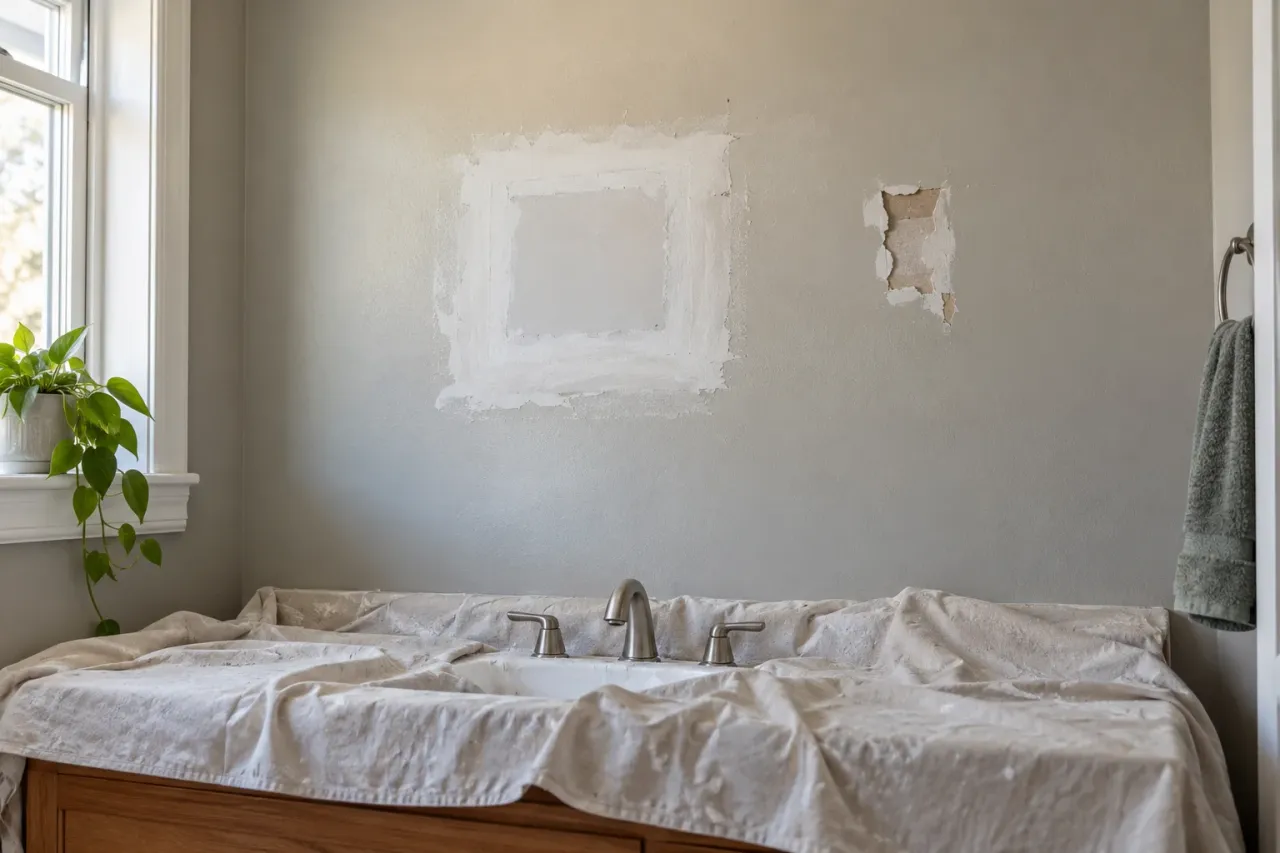
Old coatings and wall texture affect the appearance as well. Discuss the intended result under normal room lighting, particularly near a mirror light or window. If previous patches already distort the surface, the contractor should identify whether they remain outside the scope or need correction. That distinction is easier to agree before primer makes all the surfaces one colour.
The guide to why drywall repairs show through paint helps distinguish a raised edge from a difference in absorption or texture. Each issue needs the appropriate preparation. Repeatedly applying paint to an uneven patch can consume time without changing the shape that catches the light. Inspect the prepared surface before treating paint as the final correction.
Allow for finishing stages after the room looks repaired
Replacing the missing board can make the bathroom appear nearly complete, but joint work and coatings still need time. Compound application, drying, sanding and primer checks are separate operations. A schedule should describe those stages and their dependencies. Do not judge remaining work only by how much open wall is still visible at the end of the first visit.
The drywall drying guide explains why rushing from an apparently dry patch to paint can be counterproductive. Follow the selected products and the contractor's instructions for conditions during the finishing period. Keep the distinction between readiness for the next coat and readiness for normal bathroom use clear in the handover discussion.
If this is the only bathroom, agree on practical arrangements before the repair starts. Work around fixtures, protected surfaces and wet coatings can affect use even after plumbing is connected. Ask each responsible trade for its release point. A sequence based on the complete room is more useful than separate promises from individual trades about their own last visit.
Compare the full Grimsby reinstatement scope
For drywall repair in Grimsby, the quote should separate investigation or remediation by others from board and finishing work. Identify protection, removal where included, backing, joint treatment, sanding, primer, paint and cleanup. Name exclusions plainly. A cheaper total that ends at unpainted board cannot be compared directly with a complete finished-room scope.
Ask whether trim, sealant interfaces and fixture-related repairs are included or handled by another trade. These small boundaries can leave a project feeling unfinished even after the main wall has been repaired. The estimate should state where the drywall contractor stops and what the next person must do. It is easier to coordinate this while scheduling than during the final invoice discussion.
Price uncertainty should also be explicit. Some quantities may depend on findings after access or preparation. Agree what is confirmed, what is provisional and how a change is approved. This does not require an inflated allowance for every possible problem. It requires a clear way to respond if the actual condition differs from the visible information used to prepare the estimate.
Keep a useful record at the final walkthrough
Review the completed repair against the marked scope and normal viewing conditions. Check the surface transitions, repaint limits, trim boundaries and cleanup. Confirm any outstanding work assigned to another trade. If something is incomplete, record the specific item rather than leaving the whole project described vaguely as almost finished. Clear notes make the remaining action easy to arrange.
Keep the product and paint information along with the relevant repair photographs. This is useful for later touch-ups and for understanding what was rebuilt. Do not label the finishing contractor's completion as proof that every earlier building issue has been resolved unless the responsible professional has provided that confirmation. Each record should say what it actually establishes.
When your bathroom is ready for reinstatement, send EPF the repair details for a written quote. Include the location, dimensions, retained finishes and information from the trades that addressed the source. We can then discuss the wall or ceiling work on its own merits and define a finished result that is practical to inspect and maintain.
FAQ
Can drywall repair start as soon as the leak stops?
Not automatically. The responsible professionals need to establish that the source and any required drying or remediation have been addressed before enclosure. The reinstatement scope follows that handoff.
Will the replacement be the same size as the stain?
The stain does not define the repair boundary. Material condition, support and nearby finishes affect the section that can be repaired properly. The finishing and repaint areas may be larger again.
Does a drywall quote include mould remediation?
Only a clearly stated scope can establish what is included. This guide concerns reinstatement; assessment and remediation should be handled by appropriate professionals and documented separately.
Can existing bathroom tile stay during the repair?
Sometimes, but the boundary and any affected waterproofing assembly must be assessed by the responsible installer. Do not assume a painted-wall patch method is suitable inside a shower system.
What information helps an after-leak estimate?
Provide room photos, dimensions, visible repair boundaries, retained finishes and the information available from the source-repair or restoration work. Identify anything that remains unresolved.
Drywall service pages and guides
Plan the Right Drywall Service Next
Field Photos
Bathroom planning illustrations

Article Review
AuthorEPF Pro Services
Reviewed byEPF Pro Services
UpdatedOctober 18, 2026
Plan your drywall scope
Get a drywall quote today
Share photos, room sizes, and timing. We reply the same day with Grimsby drywall availability and a clearer written scope.
Quick next step